Natural capital are natural assets in their role of providing natural resource inputs and environmental services for economic production. Natural capital is generally considered to comprise three principal categories: natural resource stocks, land and ecosystems. All are considered essential to the long-term sustainability of development for their provision of “functions” to the economy, as well as to mankind outside the economy and other living beings[1].
Long‐term development is a process of accumulation and sound management of a portfolio of assets—manufactured capital, natural capital, and human and social capital. It is from Natural Capital that humans derive a wide range of services, often called ecosystem services[2], which make human life possible. The figure below depicts Natural Capital and its relation to other forms of “Capital” and the generation of ecosystem services:
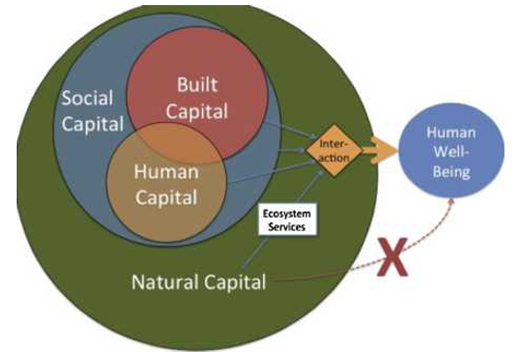
Yet, these natural assets do not appear on traditional balance sheets and can therefore be invisible in decision-making. As a result, ecosystems are deteriorating worldwide, and with them, the capacity to support human wellbeing and sustainable economic growth
Note
[1] Definition by the Organization for Economic Cooperation and Development (OECD)
[1] The most obvious ecosystem services include the food we eat, the water we drink and the plant materials we use for fuel, building materials and medicines. There are also many less visible ecosystem services such as the climate regulation and natural flood defences provided by forests, the billions of tonnes of carbon stored by peatlands, or the pollination of crops by insects.